Indonesia among few countries with the largest tropical forest that contribute oxygen for the world to breath. Indonesia’s forest and its flora and fauna that inhabits within the forest area make a strong highlight to share the global spotlight together with the Amazon. Indonesia is in the second place of terrestrial biodiversity worldwide, or, the first if combined with marine biodiversity (LIPI, 2017). Sumatran rhinos and tiger, hornbills, orangutan, Bornean elephant, Komodo dragon, Cendrawasih, are few of the other awesome endemic wildlife of Indonesian forests. Indonesia’s forests are essential not only for its biodiversity, but also are key to rural economic development and a cultural heritage for indigenous communities (Masyarakat Adat). In this note of Data Bicara, we will dive into a general overview of two forest ecosystems namely Mangrove and Peatland.
Mangrove
Mangrove is a coastal vegetation that has specific morphology with rooting system which can adapt to the tidal condition with muddy substrates. More than 23 percent of global mangroves are in Indonesia (National Mangrove Map, 2021). Indonesia is a home to the largest mangroves area in the world with 3,36 million hectares of mangroves cover (Directorate of Land and Water Conservation, DG of Watershed Management and Forest Rehabilitation, Ministry of Environment and Forestry, 2021). The top three provinces with the largest area of mangroves are Papua (1,09 million hectare), West Papua (almost 0,5 million hectare), and Riau (0,23 million hectare).
Mangrove provides valuable ecosystem services that contribute to human wellbeing, including coastal protection, climate, fisheries, raw materials and cultural services. On average these services yield totally USD 15,000/ha up to nearly USD 50,000/ha annually in benefit. It offers protection function and cultural function range from research and education, science, ecosystem services, non-timber forest products, and food supply.
Mangrove ecosystem provide the following immersive ecological, social, and economics to human and environment:
- Ecosystem service (the total economic value provided by Indonesian mangroves from their ecosystem services is estimated at USD 1,5 billion/year (World Bank, 2022));
- Water filter (two up to five hectares of mangrove area can process pond waste area of one hectare);
- Coastal protection (mangrove five times more cost-effective than concrete infrastructure);
- Climate regulator (the potential for carbon storage in mangrove is three to five times higher compared to mainland tropical forest);
- Fisheries (more than 3,000 species of fish are found in the mangrove ecosystem);
- Ecotourism with attractions such as boat tours, boardwalks, kayaking, fishing, edu-tourism;
- Livelihood sources for millions of people live within and in adjacent to mangroves; and so on.
Peatland
From several researches we know that globally all peatlands together store at least 550 Gigatonnes of carbon in their organic soils. This is twice the amount of carbon stored in the world’s forests. These peatlands sequester carbon in their soil and thus help to limit global climate change. With its area accounting for around 6% of the Earth’s surface area, approximately 40% of all known plant and animal species living or breeding in inland waters. Peatlands account for only up to 3% of Earth’s total land surface, and yet they are the largest terrestrial organic carbon sinks, storing twice as much carbon as all of the world’s forests, up to 46% of soil carbon and about 25% of organic carbon globally.
Indonesia is home to the largest area of tropical peatlands of any country (more than 24 million hectares) of peatlands – making up approximately 36 per cent of the world’s total tropical peatlands which hold an estimated 55 billion to 57 billion metric tons of carbon. This is the equivalent of almost two years of global carbon emissions at existing rates. Indonesia has more than 500 tropical peatland ecosystems that stretch from Aceh to Papua – about the distance from Portugal to Moscow (Head of Indonesia’s Peatland Restoration Agency (BRG), 2020).
Key material life-support values provided by peatland are:
- regulation of soil condition;
- regulation of catchment hydrochemistry and hydrology;
- regulation of local, regional, and global climates;
- water reservoirs for hydro-electricity and irrigation;
- agriculture as well as horticulture; and
- forestry.
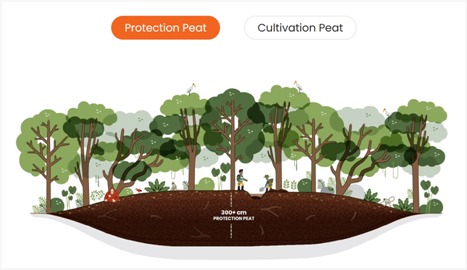
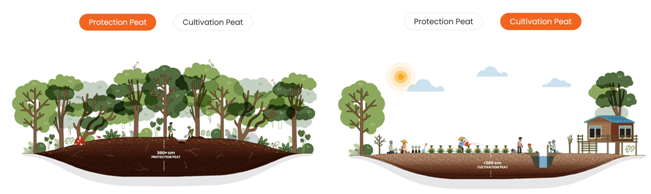
Peatlands serve as a major carbon sink. Their defining feature is a thick soil layer of leaf litter and other dead vegetation in a waterlogged state, meaning it cannot fully decompose, which prevents vast amounts of carbon emissions. Its important role is also range from biodiversity conservation (protection peat), water resource management, and rural livelihoods (cultivation peat). Tens of millions of people live in Indonesia’s peatland areas (BRG, 2020).
Recently, the Ministry of Environment and Forestry (MoEF-Kementerian Lingkungan Hidup dan Kehutanan) predicted that the potential carbon market in Indonesia would reach up to IDR 350 trillion. This includes carbon sequestration from mangrove (33 billion tCO2e) and peatland area (55 billion tCO2e). Both, mangroves and peatland are key to climate mitigation and adaptation as well as disaster risk reduction and their improved condition is therefore essential to provide vital connectivity between all ecosystems through their physical, chemical, and ecological processes.