DATA bicara
Data Bicara menjadi bagian dari forestandbeyond.id yang akan mengulas dan men-sari-kan tulisan yang bersumber dari peer-reviewed jurnal, baik yang ditulis sendiri maupun tulisan orang lain. Data dalam bentuk kuantitatif maupun kualitatif, akan berbicara dan menyajikan fakta. Data dapat membuktikan keselarasan dengan teori maupun sebaliknya - akan memperbaharuinya. Semoga tulisan dalam Data Bicara ini dapat menyajikan sesuatu yang menarik untuk dikulik dan membangkitkan rasa penasaran untuk meneliti lebih dalam.
Peer-reviewed I
Terbatasnya informasi berbasis data terkait nilai ekonomi hutan bagi masyarakat yang tinggal di dalam dan sekitar kawasan hutan, menjadi salah satu alasan yang membuat hutan kurang diprioritaskan dalam pembangunan di daerah. Benar bahwa potensi masing-masing daerah berbeda. Namun bukan berarti bahwa daerah yang memiliki tutupan hutan yang lebih luas akan tertinggal jika tidak membabat hutannya atas nama pembangunan atau peningkatan ekonomi. Restorasi pun kini dapat di-komersial-kan (atau dengan terminologi lain di-bisnis-kan) secara lebih inovatif. Misalnya, selain mengembangkan Hasil Hutan Bukan Kayu yang sudah jamak diterapkan, beberapa bagian areanya dapat dibangun untuk kawasan tujuan ekowisata ataupun yang terkini mempersiapkannya untuk menjemput peluang menjual stok karbonnya.
Seberapa besar kontribusi matapencaharian berbasis lingkungan (kehutanan, perkebunan, dan pertanian), bagi pendapatan rumah tangga masyarakat (termasuk Masyarakat Adat) yang tinggal di dalam dan di sekitar Kawasan hutan restorasi? Dan seberapa besar mereka menggantungkan mata pencaharian mereka pada eksistensi kawasan hutan restorasi tersebut? Dua pertanyaan mendasar akan Anda temukan jawabannya di tulisan berikut. Selamat membaca!
Contribution of Forest Restoration to Rural Livelihoods and Household Income in Indonesia (Nayu Nuringdati Widianingsih, Ida Theilade and Mariève Pouliot, 2016)
Abstract: Forest resources remain vital to the survival of many rural communities, though the level of forest reliance varies across a range of sites and socio-economic settings. This article investigates variation in forest utilization across households in three ethnic groups living near a forest restoration area in Sumatra, Indonesia. Survey data were collected on 268 households, with a four-month recall period and three repeat visits to each selected household within a year. Random sampling was applied to select households in five villages and five Batin Sembilan (indigenous) semi-nomadic groups. Sampled households belonged to three ethnic groups: 15% were Batin Sembilan, 40% Local Malayan, and 45% Immigrant households. Indigenous households displayed the highest reliance on forests: 36% of their annual total income came from this source, as compared with 10% and 8% for Local and Immigrant households, respectively. Our findings showed that the livelihoods of indigenous groups were still intricately linked with forest resources, despite a rapid landscape-wide transition from natural forest to oil palm and timber plantations.
Peer-reviewed II
Maraknya konversi kawasan hutan negara (baik berhutan atau tidak) menjadi perkebunan kelapa sawit, memotivasi pemerintah Indonesia untuk memberlakukan moratorium perkebunan kelapa sawit di hutan primer dan/atau lahan gambut. Pemerintah di periode bersamaan membuka ijin untuk pengusahaan restorasi ekosistem dalam kawasan hutan alam eks perijinan perkebunan atau hutan tanaman. Namun, langkah tersebut tentu saja belum cukup mengurangi deforestasi dan degradasi hutan.
Keberhasilan restorasi tak hanya soal kebijakan pemerintah pusat dan dukungan pemerintah daerah. Tak juga berhasil hanya dengan menggalakkan penanaman dan rehabilitasi yang massif dan intensif. Lebih kompleks dari itu, ternyata keberhasilan restorasi berkaitan erat dengan tata guna lahan di sekitar kawasan restorasi tersebut. Yang lebih menariknya lagi, ternyata faktor sosial ekonomi masyarakat yang tinggal di dalam dan sekitar kawasan restorasi juga memberikan dampak baik positif maupun negatif bagi keberhasilan praktik restorasi. Pun demikian dengan budaya, yang paling sederhananya diwakilkan oleh faktor etnis, ternyata juga memiliki peran dalam keberhasilan mencapai tujuan restorasi. Nah, bagi yang ingin memahami keterkaitan antara beberapa faktor tersebut, tulisan berikut bisa dipakai sebagai salah satu referensi ya. Selamat membaca!
Land use, income, and ethnic diversity in the margins of Hutan Harapan – A rainforest restoration concession in Jambi and South Sumatra, Indonesia (Nayu Nuringdati Widianingsih, Wahyudi David, Mariève Pouliot, Ida Theilade)
Abstract: Recent initiatives at a global scale have called for unprecedented levels of forest restoration to counteract decades of rapid deforestation. This study of the first rainforest restoration concession granted in Indonesia investigates the association between land use, ethnicity, migration, agricultural intensification, concession types, and household incomes. Understanding the effect of agricultural expansion and immigration on the rural landscape requires quantification of the land use and income sources of households residing in the forest margin where dynamic agricultural, socioeconomic development and forest loss takes place. The study is based on an environmentally augmented income survey covering 236 randomly selected households in five villages and five indigenous, semi-nomadic Batin Sembilan sub-groups, scattered in and around Hutan Harapan. Land use ranges from the cultivation of subsistence food through agroforestry, home gardens, and paddy fields to the development of rubber and oil palm plantations for cash income. Indigenous households were more likely to practice agroforestry than non-indigenous households. Among non-indigenous households, Malays maintain their traditional practice of rubber cultivation while more recent immigrants use land to oil palm plantations. Households residing within timber plantation concessions are more likely to establish rubber monoculture and agroforestry, while households residing in the vicinity of oil palm concessions plant oil palm. Reserving land for forest restoration affects ethnic groups differently. The traditional agricultural practices of the indigenous Batin Sembilan were well-suited to co-exist with the forest restoration concession. However, the Batin Sembilan recently adopted oil palm cultivation as practiced by immigrants in the surrounding oil palm concessions confirming that land use outcomes may be induced by neighbourhood spill-over effects.
Indonesian Mangrove and Peatland are Iconic, Let Us Appreciate Them!
Indonesia among few countries with the largest tropical forest that contribute oxygen for the world to breath. Indonesia’s forest and its flora and fauna that inhabits within the forest area make a strong highlight to share the global spotlight together with the Amazon. Indonesia is in the second place of terrestrial biodiversity worldwide, or, the first if combined with marine biodiversity (LIPI, 2017). Sumatran rhinos and tiger, hornbills, orangutan, Bornean elephant, Komodo dragon, Cendrawasih, are few of the other awesome endemic wildlife of Indonesian forests. Indonesia’s forests are essential not only for its biodiversity, but also are key to rural economic development and a cultural heritage for indigenous communities (Masyarakat Adat). In this note of Data Bicara, we will dive into a general overview of two forest ecosystems namely Mangrove and Peatland.
Mangrove
Mangrove is a coastal vegetation that has specific morphology with rooting system which can adapt to the tidal condition with muddy substrates. More than 23 percent of global mangroves are in Indonesia (National Mangrove Map, 2021). Indonesia is a home to the largest mangroves area in the world with 3,36 million hectares of mangroves cover (Directorate of Land and Water Conservation, DG of Watershed Management and Forest Rehabilitation, Ministry of Environment and Forestry, 2021). The top three provinces with the largest area of mangroves are Papua (1,09 million hectare), West Papua (almost 0,5 million hectare), and Riau (0,23 million hectare).
Mangrove provides valuable ecosystem services that contribute to human wellbeing, including coastal protection, climate, fisheries, raw materials and cultural services. On average these services yield totally USD 15,000/ha up to nearly USD 50,000/ha annually in benefit. It offers protection function and cultural function range from research and education, science, ecosystem services, non-timber forest products, and food supply.
Mangrove ecosystem provide the following immersive ecological, social, and economics to human and environment:
- Ecosystem service (the total economic value provided by Indonesian mangroves from their ecosystem services is estimated at USD 1,5 billion/year (World Bank, 2022));
- Water filter (two up to five hectares of mangrove area can process pond waste area of one hectare);
- Coastal protection (mangrove five times more cost-effective than concrete infrastructure);
- Climate regulator (the potential for carbon storage in mangrove is three to five times higher compared to mainland tropical forest);
- Fisheries (more than 3,000 species of fish are found in the mangrove ecosystem);
- Ecotourism with attractions such as boat tours, boardwalks, kayaking, fishing, edu-tourism;
- Livelihood sources for millions of people live within and in adjacent to mangroves; and so on.
Peatland
From several researches we know that globally all peatlands together store at least 550 Gigatonnes of carbon in their organic soils. This is twice the amount of carbon stored in the world’s forests. These peatlands sequester carbon in their soil and thus help to limit global climate change. With its area accounting for around 6% of the Earth’s surface area, approximately 40% of all known plant and animal species living or breeding in inland waters. Peatlands account for only up to 3% of Earth’s total land surface, and yet they are the largest terrestrial organic carbon sinks, storing twice as much carbon as all of the world’s forests, up to 46% of soil carbon and about 25% of organic carbon globally.
Indonesia is home to the largest area of tropical peatlands of any country (more than 24 million hectares) of peatlands – making up approximately 36 per cent of the world’s total tropical peatlands which hold an estimated 55 billion to 57 billion metric tons of carbon. This is the equivalent of almost two years of global carbon emissions at existing rates. Indonesia has more than 500 tropical peatland ecosystems that stretch from Aceh to Papua – about the distance from Portugal to Moscow (Head of Indonesia’s Peatland Restoration Agency (BRG), 2020).
Key material life-support values provided by peatland are:
- regulation of soil condition;
- regulation of catchment hydrochemistry and hydrology;
- regulation of local, regional, and global climates;
- water reservoirs for hydro-electricity and irrigation;
- agriculture as well as horticulture; and
- forestry.
Peatlands serve as a major carbon sink. Their defining feature is a thick soil layer of leaf litter and other dead vegetation in a waterlogged state, meaning it cannot fully decompose, which prevents vast amounts of carbon emissions. Its important role is also range from biodiversity conservation (protection peat), water resource management, and rural livelihoods (cultivation peat). Tens of millions of people live in Indonesia’s peatland areas (BRG, 2020).
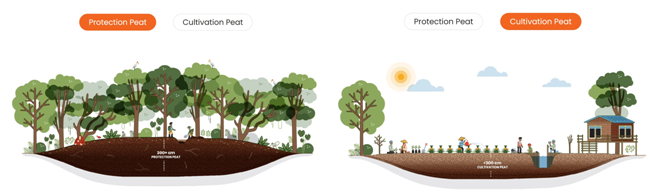
(Picture source: https://en.pantaugambut.id/peat-101/peat-ecosystem-functions)
Recently, the Ministry of Environment and Forestry (MoEF-Kementerian Lingkungan Hidup dan Kehutanan) predicted that the potential carbon market in Indonesia would reach up to IDR 350 trillion. This includes carbon sequestration from mangrove (33 billion tCO2e) and peatland area (55 billion tCO2e). Both, mangroves and peatland are key to climate mitigation and adaptation as well as disaster risk reduction and their improved condition is therefore essential to provide vital connectivity between all ecosystems through their physical, chemical, and ecological processes.