Where the Forest Meets Daily Life
In many forest villages, the day begins long before formal meetings are called or development plans are written. Smoke rises from kitchen fires, children prepare for school, farmers walk toward their fields, and women move between household work, food preparation, caregiving, and the gathering of forest products that sustain everyday life. The forest is not a distant landscape in these communities. It is a source of food, medicine, fuel, income, memory, and responsibility.
Yet the people who depend on forests do not always stand in the same position when decisions are made. Women and men often experience the forest differently because their daily responsibilities are different. These differences shape what they know, what they need, and what they protect. When forest governance overlooks women’s voices, it risks missing the knowledge carried through daily practice: which plants heal, which products support household survival, and which parts of the forest are most vulnerable.
The Knowledge Women Carry
Women’s forest knowledge is often built through tradition, observation, and care. A mother who prepares food may recognize the fruits, leaves, or roots that can fill a household meal. A caregiver may remember which plants are used for fever, wounds, or stomach pain. These forms of knowledge may not always appear in official plans, but they are central to how families survive and how forests are used responsibly.
Men may be more closely associated with forest products that bring cash income, such as timber or commercial non-timber forest products. Women, on the other hand, often prioritize trees and plants that serve many purposes at once: food for the family, medicine for children, fuel for cooking, fodder for livestock, and materials that help keep the household secure. These priorities are not in competition with one another. Together, they reveal that forest management is strongest when it listens to different kinds of needs and experience.
In Indonesia, however, women’s contributions are not always matched by equal influence in formal decision-making. Village meetings may be dominated by men, information may circulate through male networks, or meeting times may clash with women’s household responsibilities. As a result, women can be deeply involved in forest-based livelihoods while still being treated as secondary participants in forest governance. A more inclusive approach begins by recognizing that women are not merely beneficiaries of forest programs. They are knowledge holders, organizers, protectors, and leaders.
A Grassroots Beginning in Delima Village
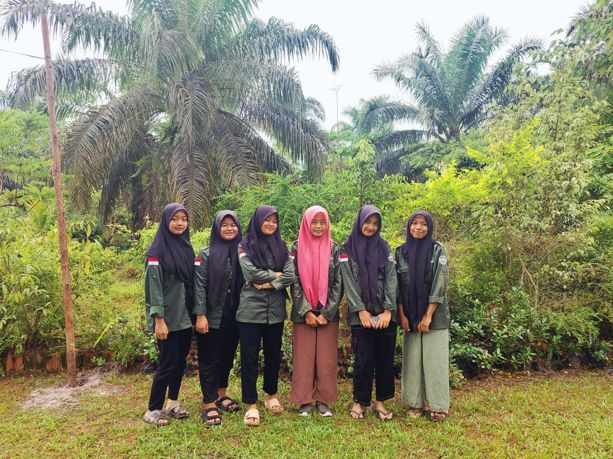
In Delima Village, Tanjung Jabung Barat District, Jambi, a small initiative began with a simple conviction: the forest around the village needed to be protected, and the community itself had to be part of that protection. From this conviction grew Sanggar Alam Delima, or SAD Institute, a local community group officially inaugurated by the Head of Tanjung Jabung Barat District in August 2021.
The institute did not begin with a large budget or a formal program. It emerged from the initiative of a local female champion and her son, who started organizing activities with their own resources. They invited community members to learn practical forestry skills: how to develop nurseries, plant trees, and use organic fertilizer. What began as small acts of learning gradually became a shared effort to care for the forest.
Delima Village is surrounded by timber concession areas managed by private companies, making forest protection both urgent and complicated. In this setting, SAD Institute became more than a training space. It became a place where local people, especially women and youth, could see themselves as guardians of the landscape around them. Female youth members joined regular forest patrols, helping reduce illegal logging and forest degradation. Their approach was not built on confrontation. Instead, it relied on patience, conversation, and trust. Female patrol members often approached families quietly, explained why forest protection mattered, and encouraged change through relationships rather than force. Their work shows that conservation is not only about guarding trees. It is also about nurturing a sense of shared responsibility, one conversation at a time.
Red Ginger, Rattan, and Leadership in Todowongi
Far from Jambi, in Todowongi Village, North Maluku, another story of women’s leadership unfolded through social forestry. The village obtained a social forestry license that gave the community legal access to manage approximately 495 hectares of state forest. Under the leadership of Mancelina Lobby, the Head of Todowongi Village, this legal access became the foundation for a village green economy.
For generations, people in Todowongi had cultivated red ginger in forested areas. They knew its value not only as a plant, but as part of household health, local knowledge, and village livelihood. With the social forestry license and support for capacity building, red ginger began to move beyond small-scale cultivation. Community members intensified the planting through agroforestry system, improved production, processed ginger into powdered drinks, and found new ways to market their products.
The forest also offered rattan, another resource that could now be used legally and more productively. Alongside ginger processing, villagers began developing rattan-based furniture. These activities created new income opportunities without separating livelihood from forest stewardship. Powdered ginger sales reportedly reached IDR5 million per month, helping families meet daily needs and support children’s education, while demand for rattan furniture continued to grow.
Lobby’s leadership helped turn these scattered opportunities into a more organized village enterprise. Todowongi established a production house equipped with tools for processing ginger and rattan products. She encouraged partnerships among village-owned enterprises, promoted products through social media, and allocated village funds to support local businesses. Through these efforts, forest governance became visible not only in permits and plans, but in the everyday work of processing, marketing, earning, and reinvesting in the village.
What These Stories Teach Us
The stories of Delima and Todowongi show that women’s participation in forest governance does not follow only one path. In one village, women and youth protect the forest through patrols, conversations, and community education. In another, a woman village leader helps transform forest products into economic opportunities. In both places, women’s roles are rooted in local knowledge, daily responsibility, and commitment to the future of their communities.
These stories also remind us that inclusion is not achieved simply by counting how many women attend a meeting. Meaningful inclusion asks deeper questions: Who has the confidence to speak? Who receives information early enough to act? Who controls resources? Whose knowledge is treated as valuable? Whose priorities shape the plan? When women are invited not only to participate but to influence decisions, forest governance becomes more connected to household needs, livelihood security, and long-term ecological preservation.
Seeds of Change
Grassroots movements often begin quietly: with a nursery, a patrol, a meeting under a village roof, a production house, or a woman who refuses to see the forest as someone else’s responsibility. The experiences of SAD Institute and Todowongi Village show that women are not passive beneficiaries of forest programs. They are protectors, teachers, entrepreneurs, leaders, and agents of change. When their knowledge is recognized and their leadership is supported, forests can become not only spaces of conservation, but also places where communities build resilience and hope.